7 Golf Swing Drills to Practice at Home and on the Range
Choose golf swing drills based on a repeated pattern: changing posture, rushed transitions, inconsistent contact, or loss of balance. Work on one issue and track a clear result before switching exercises. This Alegolf Vietnam guide explains seven drills for home and range practice, plus a focused 20-minute routine.
Choose a drill based on what you want to improve
Hit five balls with the same club and aim at one target. Notice where each shot starts, where you strike the ball on the face, and whether you can finish in balance. These observations help you assess the fundamentals of your basic golf swing and identify areas for improvement. If you’re hitting from grass, look at where the club touches down. A pattern across those shots gives you a better starting point than the result of your last swing.
|
What you notice |
Drill to try first |
How to check your progress |
|
Your setup changes from swing to swing |
Mirror setup drill |
You can step away and recreate the same stance and posture. |
|
You rush when the club changes direction |
Slow-motion rehearsal |
You can make the same turn at a steady pace. |
|
You step or stumble after impact |
Hold-the-finish drill |
You can stay balanced at the end of the motion. |
|
You hit the ground before the ball |
Line contact drill |
The club begins brushing the turf closer to the target side of the line. |
|
Contact gets worse as you swing harder |
Half-swing progression |
You can lengthen the swing while keeping contact fairly consistent. |
|
Your shots start off line |
Alignment station |
You can check your aim before judging the ball’s starting direction. |
|
Your setup gets less consistent when you change targets |
One-ball target drill |
You can repeat your routine with a different club or target. |
Three golf swing drills you can do at home
You can do all three without hitting a ball. If the space is tight, rehearse with your hands together or your arms crossed. Use a club only when there’s enough clearance around and above you for the whole motion.
1. Mirror setup drill
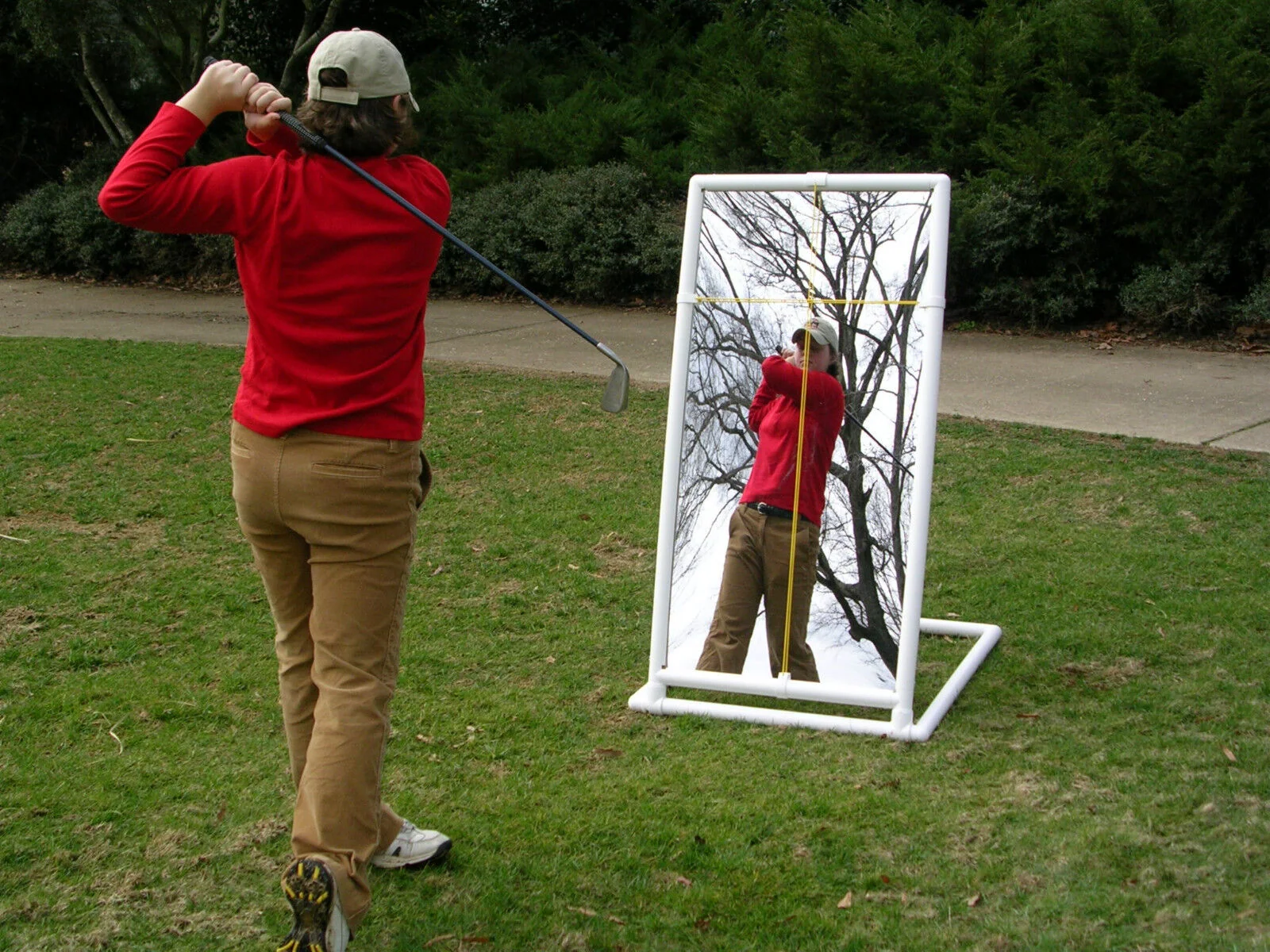
Stand side-on to a mirror and take the posture you’d use with a mid-iron. Bend comfortably from your hips, soften your knees, and let your arms hang. Glance at the mirror and notice whether your arms sit naturally under your shoulders or reach forward. Move slightly closer to or farther from your imaginary ball if you need to.
Step away, then return to your setup five times. Look forward as you settle in and glance at the mirror afterward to check what changed. If your arms hang naturally on the first attempt but reach farther on the next two, work on standing the same distance from the ball. Once you can repeat that, check your stance width or ball position. For more tips on proper hand positioning and grip pressure, refer to our golf grip guide.
2. Slow-motion swing rehearsal
Cross your arms over your chest and take your normal stance. Turn back slowly until you reach a position you can control, then turn through toward the target. As you change direction, feel pressure begin to move toward your lead foot, the foot closer to the target. Pause at the finish and check that you can hold it comfortably.
Repeat five times. If you speed up each time you start down, shorten your turn and give yourself time to feel the change of direction. At the range, make one slow rehearsal before hitting an easy half shot. Use the rehearsal to remind yourself how the transition feels, then judge the shot by contact and balance.
3. Hold-the-finish drill
Make a small practice swing and hold your finish for a count of three. Notice whether you have to step, straighten suddenly, or shift your feet to stay upright. If you do, reduce the length or speed of the motion until you can finish comfortably.
Build up gradually. Try three short rehearsals, then three slightly longer ones. Pay attention to the point where you start losing your balance. If the shorter motion feels steady and the longer one feels rushed, use the shorter version to warm up on the range. Add speed once you can finish the same way with a ball in front of you.
Four golf swing drills to try on the range
4. Line contact drill
On a grass range where the facility allows it, mark a short line across your target line with a tee. Place the ball on the mark and hit a few half shots with a short iron. After each shot, check where the turf first shows a mark. For a standard iron shot, a mark that begins on the target side is a useful sign that you reached the ball before brushing the turf.
If the marks repeatedly begin behind the line, check your ball position and shorten the swing before trying again. On a mat, place a small flat towel several inches behind the ball as a reference if the range allows it. Try to strike the ball without touching the towel. Use the feedback to compare several swings before making another change.
5. Half-swing progression drill
Pick a target you can reach comfortably with a short iron. Start with five shots using a backswing that takes your hands to about waist height. Pay attention to where the ball meets the face and whether the strike feels similar from shot to shot. If several strikes feel solid, lengthen the backswing slightly for the next five balls.
Suppose the half shots are clean, but the longer swings produce several thin strikes. Return to the shorter motion for two or three balls, then try a smaller increase in length. That gives you a clearer idea of how much swing you can control today. You can use the same progression with a mid-iron before moving to a longer club.
6. Alignment station drill
Choose a target and aim the clubface at a spot just ahead of your ball on the intended starting line. Place an alignment stick flat on the ground parallel to that line, near your toes and clear of the club’s path. Use it to check your foot line, then glance back at the clubface. The stick gives you a separate reference for your feet and the face.
Hit five balls and note where each starts. Then move the stick away and set up for three more shots. If your aim changes as soon as you remove it, practice picking an intermediate target and rebuilding the setup each time. If your setup looks consistent but the ball still starts to one side, a coach can help you check what the face is doing at impact.

7. One-ball target drill
Choose a target, go through your usual setup, and hit one ball. For the next shot, change the target or the club. You might hit a short iron to a nearby marker, then a mid-iron to a different target, then return to the short iron. Give yourself enough time to aim and settle into your stance before each shot.
Use the same swing cue throughout, such as a smooth transition or a balanced finish. After six shots, look for the point where your routine started to change. You can incorporate PGA swing practice drills into your training to reinforce consistent movements and improve your swing technique. If you aim carefully with a short iron but rush when you pick up a longer club, work on taking the same time to set up with both. That habit is useful when you play a round and every shot presents a new target.
A 20-minute golf swing practice plan
A short session works well when you start with one goal. If you want to improve iron contact, for example, build the session around where the club touches the ground. Use the last few balls to see whether that contact holds up when you change targets.
|
Time |
What to practice |
What to record |
|
First 5 minutes |
Warm up with easy swings and hit a few balls with one club. |
Note your most common strike or starting direction. |
|
Next 10 minutes |
Choose one drill and practice in sets of five balls. |
Track one result, such as clean strikes or balanced finishes. |
|
Last 5 minutes |
Change the target or club and go through your normal setup each time. |
Check whether the same improvement shows up during regular shots. |
Write down one observation before you leave. “Four of five half swings felt solid, but I caught the next three-quarter shots thin” tells you where to start next time. Compare similar sets over a few sessions so you can see whether the change holds up beyond one good day.
FAQ About Golf Swing Drills
How should beginners practice a golf swing?
Start with a short iron, one target, and controlled half swings. Focus on repeatable setup and solid contact before increasing swing length or speed.
Which golf swing drills can you do at home?
Try mirror setup checks, slow-motion turns, and hold-the-finish rehearsals without hitting a ball. Practice without a club if there is not enough clearance for the full movement.
How do you check whether a drill is working?
Track one result, such as contact quality or balanced finishes, across comparable practice sets. Then hit normal shots without the drill setup to see whether the improvement carries over.
Which drill helps improve balance and contact?
The half-swing progression lets you work on both with a short iron at a manageable speed. Begin with a compact motion, check your strike and finish, then lengthen the swing gradually.
How long should a golf practice session last?
A focused 20-minute session is a useful starting point: five minutes warming up, ten on one drill, and five testing normal shots. Adjust the timing to your needs and allow more warm-up time when necessary.
Take your swing practice onto the course
Before your next round, use one familiar drill during warm-up and choose one cue for the first tee. A simple thought, such as finishing in balance, is easier to carry from shot to shot. If you’re deciding where to play, see our guide to planning a golf holiday in Vietnam. Share your travel dates, group size, and playing levels with Alegolf Vietnam so we can suggest courses that suit your group.
Destination

Hanoi Hanoi Golf Holidays

Ha Long Ha Long Golf Holidays

Da Lat Da Lat Golf Holidays

Nha Trang Nha Trang Golf Holidays

Da Nang Da Nang Golf Holidays

Ninh Binh Ninh Binh Golf Holidays

Ho Chi Minh Ho Chi Minh Golf Holidays

Phu Quoc Phu Quoc Golf Holidays
Golf Deal
Legend Danang Golf Resort: Course Guide & Tee TimesTopics of Many Interests
ALEGOLF TOUR AT ITE HCMC 2026 MEET US AT BOOTH 76 Things to Do in Ho Chi Minh City: Sights, Food & Golf Vietnam Golf Packages | All-Inclusive Golf Holidays & Tours Professional Golf Tour Operators: Designing the Perfect Vietnam Experience Corporate Events Golf in Vietnam | Professional Golf DMC Ultimate Guide to Planning Perfect Golf Holidays in Vietnam Dragon Golf Links - Unique Golf Course on the Sea FLC Ha Long Golf Club: Transcendent Moments Amidst a World Natural Wonder FLC Golf Links Quy Nhon - A Remarkable Golfing Destination Along the Central Coast FLC Sam Son Golf Links - A Great Destination for Golfers!New Posts



Comment